Black Lines Matter
- By : Nat
- Category : General, Greatest hits
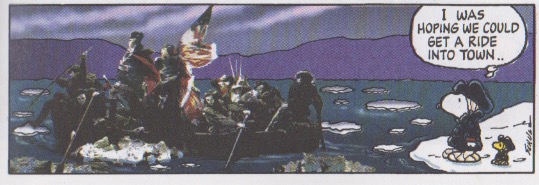
The folks putting together The Complete Peanuts series did a really good job of hunting down the best quality source for everything they reprinted. This can be particularly problematic when one is dealing with older Sunday strips, where one might not be able to find a printing or stat of the work in black-and-white, and de-coloring a scan of a color page can be trickier than you’d think. In some cases, the original art was re-shot to make the page, with the goal being to get what Schulz had originally drawn as the black line. That is the right move… generally. But… well…
This is what the final panel of the December 19, 1999 strip looked like in the first book it was reprinted in, Peanuts 2000:
And this is what it looks like in The Complete Peanuts volume 25:

(Forgive the fuzziness of the right end of that, I didn’t want to damage the book.)
In this case, the color added by Schulz’s assistant (to be specific, Emanuel Leutze, via his 1851 painting “Washington Crossing the Delaware”) was kind of vital.