Psycho-economy of Charlie Brown
- By : Nat
- Category : Uncategorized, Upcoming releases
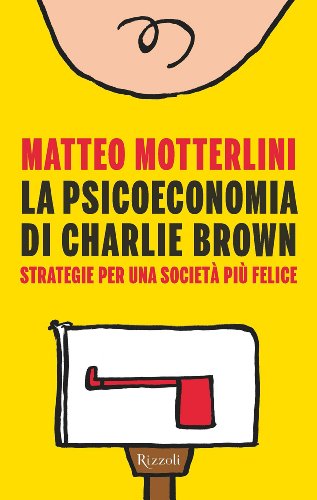 Coming next month for Kindle users (and preorderable now) is The Psycho-economy of Charlie Brown: Strategies for a happier society. Well, actually, it’s La psicoeconomia di Charlie Brown: Strategie per una società più felice, because the darned thing is in Italian. And (courtesy of Google Translate), this is what it’s about:
Nobody wants to be stressed, inefficient and accounts in red. But often we are: as individuals and as a country. This is demonstrated by the recent crisis and the persistent difficulty of governments to make us “do the right thing” pollute less, pay taxes, go to the polls, drink in moderation … Why are we so hard to govern? Because it is assumed that we are economically rational beings. Too bad it does not, as revealed by numerous field experiments and images of the brain in action. In fact we are unsure as Charlie Brown, Lucy as egocentric, lazy like Snoopy. The way to change our behavior for the better is not subissarci of recommendations, rules and bureaucracy, but gently push in the right direction. How? He explains Matthew Motterlini in this book, full of case studies and experiments curious, which outlines a workable proposition in three easy steps. The first is to create an environment more eco-friendly and healthy choice: bills and contracts more transparent, thermostats smarter, healthier school lunches, more accessible. It is the revolution of the nudge, already adopted in the United States and in some European countries.
The second concerns the policy, which should abandon the measures dictated by improvisation and ideology to base it on the evidence of the data. The third depends on us, because the “rules of Charlie Brown” apply to all decisions every day.